How To Calculate Calories Burned On A Treadmill (The Accurate Way)
Stop guessing your calorie burn. Learn exactly how to calculate calories burned on a treadmill using the gold-standard ACSM formula.
Do not risk injury testing your true max if you don't have to. Input your best set into our one rep max calculator and we will calculate 1RM across the 7 most clinically-validated strength formulas to give you a true consensus max.
Last updated:
Follow the exact steps to get your result instantly and privately.
Pick your lift (whether you need a Bench press 1RM calculator or a Squat max calculator) and input the maximum weight you successfully lifted.
Input how many clean reps you performed. (Formulas become less accurate beyond 10 reps).
We instantly run your numbers through the Brzycki formula calculator, Epley, Lombardi, O'Conner, and Wathan equations to find the statistical average.
Pick your lift (whether you need a Bench press 1RM calculator or a Squat max calculator) and input the maximum weight you successfully lifted.
Predicting a true one-rep max is physiologically complex because individuals possess drastically different ratios of muscle fiber types (fast-twitch Type II fibers geared for explosive strength versus slow-twitch Type I fibers geared for endurance). Due to these genetic variations, a single mathematical model is rarely perfect. For example, the famous Brzycki formula calculator might chronically underestimate the 1RM of an explosive athlete on the bench press, while the popular Epley formula might severely overestimate the 1RM of an endurance-heavy athlete on the barbell squat. To eliminate this inherent bias, our advanced one rep max calculator does not rely on just one equation. Instead, we instantly process your input through an ensemble average of the absolute most respected and clinically-validated strength formulas in modern sports science—including Brzycki, Epley, Lombardi, O'Conner, and Wathan. By calculating the statistical median of these renowned equations, we smooth out the biological outliers to deliver the most mathematically accurate 1RM prediction possible. Having this highly precise consensus max is absolutely essential for safely and effectively utilizing any 1RM percentage chart for advanced powerlifting or hypertrophy training programs like 5/3/1, Smolov, or conjugate periodization.
Brzycki: Weight × (36 ÷ (37 - Reps))
Epley: Weight × (1 + (Reps ÷ 30))
Lombardi: Weight × (Reps ^ 0.10)
O'Conner: Weight × (1 + 0.025 × Reps)
Wathan: Weight × 100 ÷ (48.8 + 53.8 × e^(-0.075 × Reps))If you successfully barbell squat 225 lbs for a grueling 5 repetitions, the Brzycki formula estimates your absolute 1RM at 253 lbs, while the Epley formula aggressively predicts 262 lbs. Rather than making you guess which is correct, our calculator's consensus average intelligently predicts a true 1RM of exactly 256 lbs, giving you a safe and reliable number to base your next training block around.



Strength & Conditioning Data
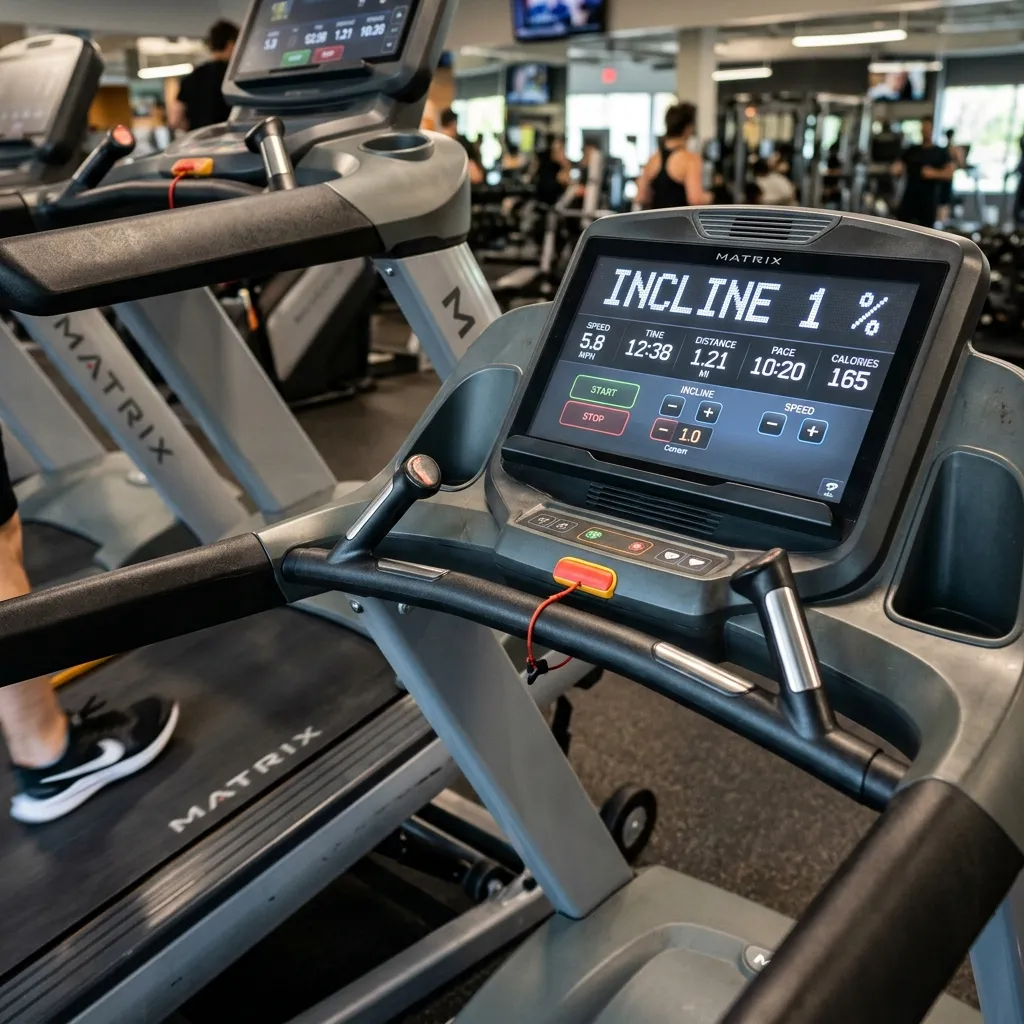
Stop guessing your calorie burn. Learn exactly how to calculate calories burned on a treadmill using the gold-standard ACSM formula.
Breaking down the exact calorie burn of the viral 12-3-30 treadmill workout and why it is so incredibly effective for weight loss.
Your treadmill display overestimates calorie burn by 15–20%. Here is the ACSM formula, how incline multiplies calories, and what the 12-3-30 actually burns.